ℹ️ Starting in v5, Ask Sourcebot and MCP will be a part of our paid plan. To learn more about this change and how to keep your current functionality, please visit our migration guide.
Sourcebot v5 is our biggest release yet. Ask Sourcebot now reaches beyond your code to the tools you work with everyday, all inside an app we've rebuilt from the ground up.
Here's what's new:
Ask connectors: bring Jira, Slack, Linear, and more into the Ask agent.
App redesign: a persistent sidebar that keeps your recent repos and chats one click away.
Git blame and history: see who changed what, and when, right in the app.
Ask connectors

Context is often scattered across dozens of platforms - Jira tickets, Slack threads, Confluence docs, etc.
Ask Sourcebot can now connect to your tools via MCP, giving it access to data and actions beyond just your code. Bring external context to help debug issues, draft specifications, and create bug reports.
For example:
Pull the top 3 highest severity bugs from Jira, investigate the root cause, and file your findings back as comments.
Turn a Linear ticket or Slack thread into an implementation spec, grounded in how your code actually works.
Create a document in Confluence for how this system works today.
App redesign

We've rebuilt the look and feel of Sourcebot around a persistent sidebar.
The sidebar stays with you everywhere in the app, so your recent repositories and chats are always one click away. Jump back into a conversation, switch to a repo you were just browsing, or start something new without losing your place.
Git blame and history
We've integrated git blame and history directly into the code browser:
When viewing a file, click the blame view to see the commit info per line.
Clicking on a commit will open the diff preview preview.
When viewing a file or directory, the History tab on the bottom bar previews the commit history.
Clicking the "View full history" tab will reveal the full commit history, with options to filter by author or by date.
Try it out on your own machine with our new setup cli: npx setup-sourcebot
What we shipped this week (Mar 23 - Mar 30):
The MCP server now supports `glob` and `list_tree` tools, letting MCP clients find files by pattern and browse directory structures in a codebase. (#1014)
The file viewer now respects `.gitattributes` language hints, so files get the correct syntax highlighting when a repo overrides the detected language. (#1048)
Search contexts can now be filtered by GitHub and GitLab topics, making it easier to scope searches to a specific group of repos. (#1028)
Fixed auto-scroll in ask threads, regex queries with parentheses being split incorrectly, line numbers being accidentally selected alongside code in Safari, and GitLab sync cleaning repos on non-404 API errors.
What we shipped this week (Mar 14 - Mar 21):
Admins can now restrict API key creation and usage to organization owners only. (#1007)
MCP `search_code` now supports filtering by file path using regular expressions. (#1008)
Redis TLS is now supported. (#1011)
Also: agent max step count raised from 20 to 100 (#1017), MCP read-only annotations for Cursor Ask mode compatibility (#1013), ask_codebase hidden when no LLM providers are configured (#1018), and SMTP individual env var support (#1002).
What we shipped this week (Mar 9 - Mar 15):
OpenAPI docs are now available for the search, repository, and file browsing APIs. (#996)
JumpCloud is now supported as an SSO identity provider. (#997)
Teams can now have multiple owners, with promote and demote actions. (#988)
Also: MCP now requires explicit invocation for ask_codebase, authentication gated when Ask GitHub is enabled.
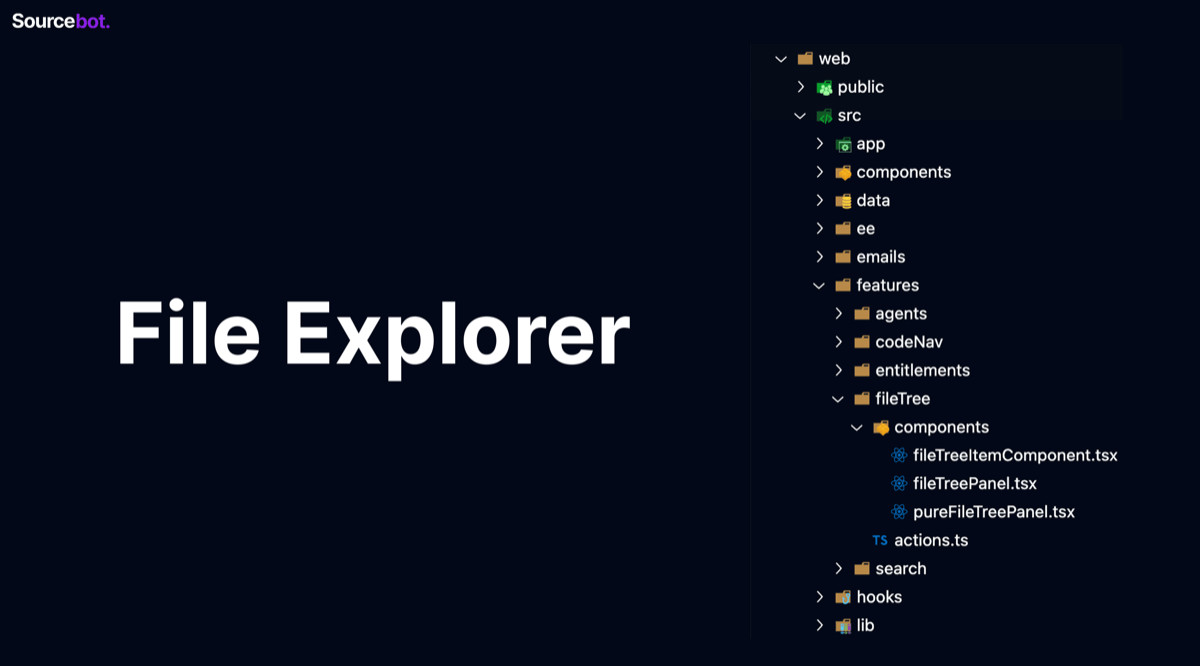
We’ve spent some time optimizing the file explorer performance for large (100k+ files) repositories. Previously, the file explorer could take 10-20 seconds to load. We’ve trimmed that time down to less than a second.
Before:

After:

Tl;DR: we’ve improved search responsiveness by a order of magnitude on larger Sourcebot deployments by implementing streaming.
When you are looking for code using code search, search speed is one of the most important metrics that determines if the experience will be good or not. Zoekt (the underlying code search engine Sourcebot uses) is exceptionally fast, delivering sub-second search times on hundreds of repositories. However, it has it’s limits - on larger Sourcebot deployments of 5k+ repositories, we noticed that certain searches could take upwards of 10 to 20 seconds to complete.
To help mitigate this, we’ve added support for streaming in search results as they are found. Previously, results would only appear after the entire search completes. With streaming, results appear as they are found.

Please note that the features outlined in this changelog require an enterprise license.
We’ve added the ability to link multiple external identity providers to a Sourcebot user. This allows you to connect to multiple different code host platforms and sync permissions across all of them. In addition, this unblocks deployment scenarios where you don’t want to use your code host platform for SSO (ex. you want to login using Okta, but you still need GitHub permission syncing).
Please check out the external identity provider docs for more info.

Happy Halloween! 🎃 We’ve been heads down solving some deep technical problems in order to make Sourcebot scalable and performant for larger instances. Here are some of the highlights of our efforts:
Improved search performance by as much as 41x for unbounded queries (#555). Performance improvements will be most notable when searching for common search terms (e.g.,
functionorlog). We are continuing to focus on improving search performance, and will have more updates soon.Improved web app responsiveness, including reducing the Time to Interactive (TTI) by as much as 10x for larger deployments. (#563)
Improved repository indexing stability with stronger concurrency primitives (#563). In our testing of indexing 10k repositories, we reduced the error rate from 5% down to 0%.
Added additional UI to view in progress jobs for repository indexing and connection syncing. (#579)
Code hosts like GitHub & GitLab support configuring access control lists (ACLs) that define what repositories a user can and cannot see. We’ve shipped experimental support for syncing these ACLs with Sourcebot. The TL;DR is:
Users sign into Sourcebot using OAuth connected to the code host (either GitHub or GitLab).
Once signed in, the user will only be able to access repositories they would have access to on the code host. Specifically:
Sourcebot periodically syncs with the configured code host to ensure what repositories the user should (or should not) have access to are up to date.
This feature is a part of our enterprise offering. If you’d like to learn more, checkout the docs.
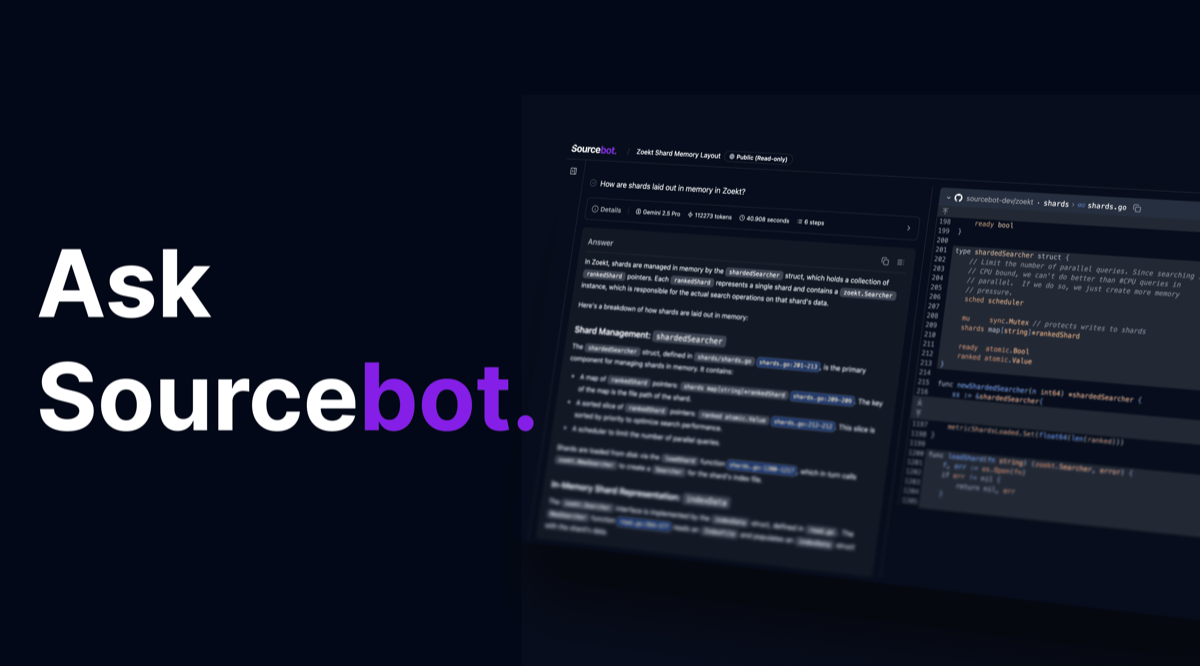
Ask Sourcebot is an agentic search tool that lets you ask complex questions about your entire codebase in natural language, and returns a structured response with inline citations back to your code. Some questions we have seen on our demo site:
“How does authentication work in this codebase? What library is being used? What providers can a user log in with?” (link)
“When should I use channels vs. mutexes in go? Find real usages of both and include them in your answer” (link)
“How are shards laid out in memory in the Zoekt code search engine?” (link)
https://framerusercontent.com/assets/eTaFa1N3AdWFnCby7nKRuEfBtV0.mp4
🔑 Key points
Ask questions about your codebase in natural language.
Get back concise responses grounded in your code with inline citations.
Bring Your Own API Key (BYOK) from over 11 different model providers (like Amazon Bedrock and Google Vertex).
@ mention files to add them as context for your question.
Scope your question to specific repositories or repo sets.
Share answers with teammates.
For more info, checkout the docs.